

What are the threads in pipes and fittings?
What is a thread?
A thread refers to the continuous raised part with a specific cross-section
formed as a helical line on the surface of a cylindrical or conical body.
On the surface of a cylinder or cone, a continuous protrusion
with a specified tooth profile is formed along a helical line.
The protrusion refers to the solid part of the sides of the thread.
Also called a tooth.
Summary of Thread Basics
1. Principle of Thread Formation
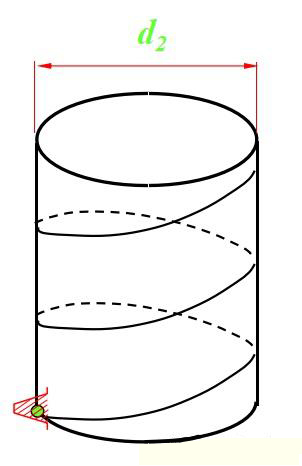
Helix: The trajectory of a moving point on the surface of a cylinder
rotating around the axis at a constant speed while moving along
the axis at a constant speed. Thread: A planar figure moves along a helix
maintaining the figure passing through the axis of the cylinder during the motion
resulting in a thread.
2.Classification of threads
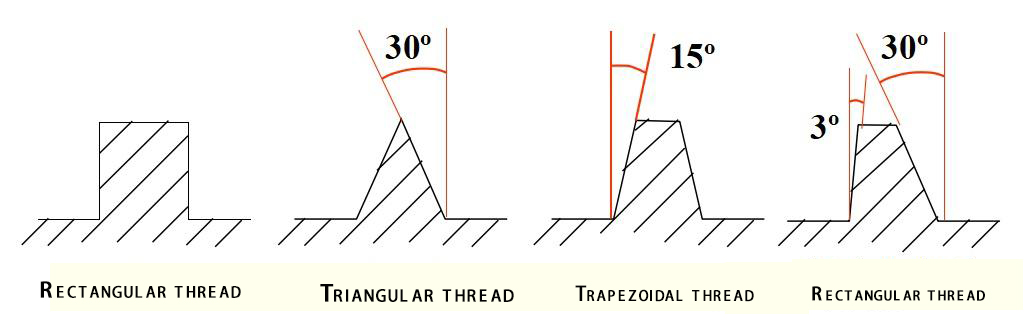
(1) According to the thread profile, they are divided into: rectangular threads
triangular threads (common threads, code M), trapezoidal threads (code Tr)
and sawtooth threads (code B).
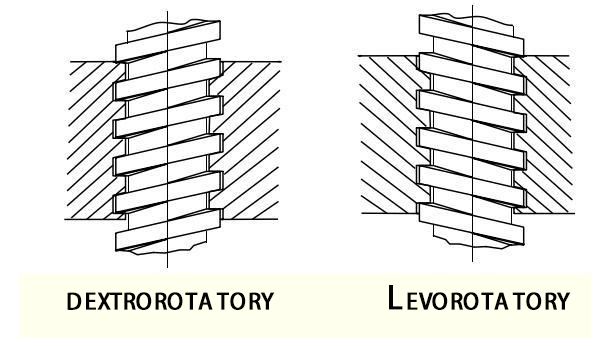
(2) Threads are classified by their direction of rotation: right-hand threads and left-hand threads.
The code for a left-hand thread is LH; if LH is not indicated, it means a right-hand thread.
(Additional knowledge: How to determine the direction of a thread?
Place the threaded hole or shaft vertically; the side where the helical line is higher indicates the rotation direction.)
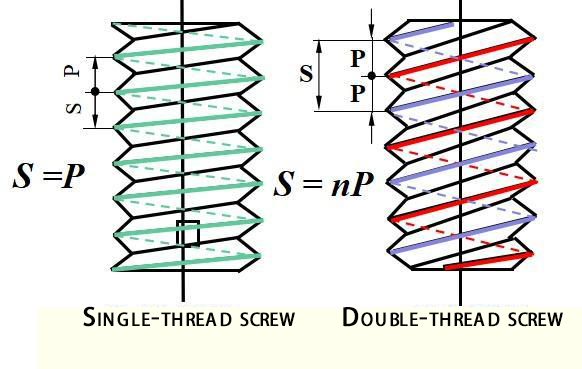
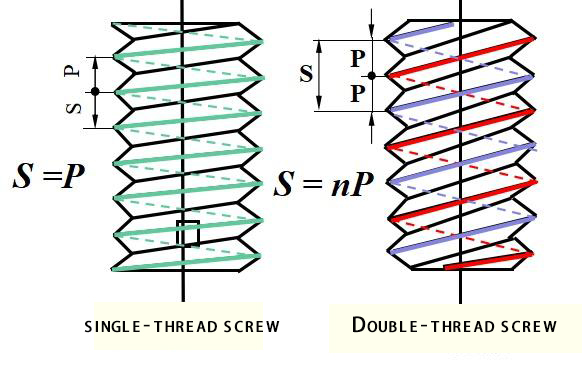
(3) According to the number of threads, they are divided into: single-threaded and multi-threaded screws.
Single-threaded screws have a smaller helix angle (less prone to slipping), which provides self-locking capability
and is used for fastening and locking. Multi-threaded screws, on the other hand, have a larger thread angle (more prone to slipping)
and are used for transmitting power and motion. Multi-start threads engage faster than ordinary threads
distribute force evenly, and are commonly used in some quick-connect interfaces
and in applications requiring variable speed.
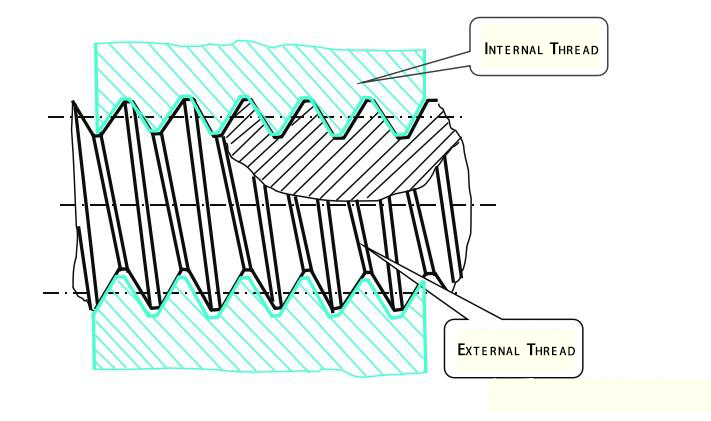
(4) Divided according to the inner and outer surfaces of the rotary body: internal thread and external thread.
(5) According to the function of the spiral, they are divided into: connecting threads (ordinary threads, pipe threads)
and transmission threads (rectangular threads, trapezoidal threads, sawtooth threads).
(6) Classified according to the shape of the parent body: cylindrical threads and conical threads
(conical threads are mainly used for pipe connections).
3.Thread parameters
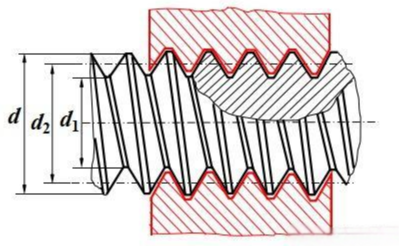
(1) Three DiametersMajor
diameter d: Defined as the nominal diameter in the standard;
Minor diameter d1: Often used as the calculation diameter for the dangerous cross-section of a screw in strength calculations.
Pitch diameter d2: The pitch diameter is the diameter of an imaginary cylinder where the grooves
and protrusions of the thread on the axial section are equal in width. The pitch diameter is
used to determine the geometric parameters and fit properties of the thread.
(2) Second premolar
Pitch P
Lead (Rise) S
(3)Two corners
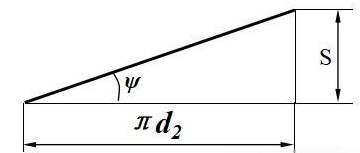
Thread Lead Angle ψ
Profile Angle α
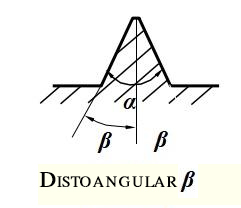
(4)Number of threads
The number of threads can also be called the number of starts (denoted by n)
referring to the number of helical threads.
Single-start threads ψ↓→ good self-locking → mostly used for connections;
multi-start threads ψ↑→ high transmission efficiency → mostly used for transmission.